One Prompt Is Not a Benchmark: Why AI App Builder Scores Need a Fixed Prompt Suite (2026)
The 2026 prompting guides of Lovable, Bolt and v0 all say prompt wording changes the output. So a single prompt cannot benchmark a builder. Why prompt sensitivity is a validity threat, and what a fixed, versioned prompt suite looks like.
On this page
Abstract. A benchmark is a controlled measurement, and the thing you control matters as much as the thing you measure. For an AI app builder the input under test is a natural-language prompt, and the builders' own documentation is explicit that the wording, structure, and specificity of that prompt change the output. This lab note argues that a single prompt is therefore not a benchmark: it measures the prompt author at least as much as the builder. Read directly from the 2026 prompting guides of Lovable, Bolt, and v0, it sets out why prompt sensitivity is a validity threat, what a fixed and versioned prompt suite looks like, and how BuilderProof handles it. It applies to every builder in the cohort equally. None is singled out.
Quick answer (July 2026)
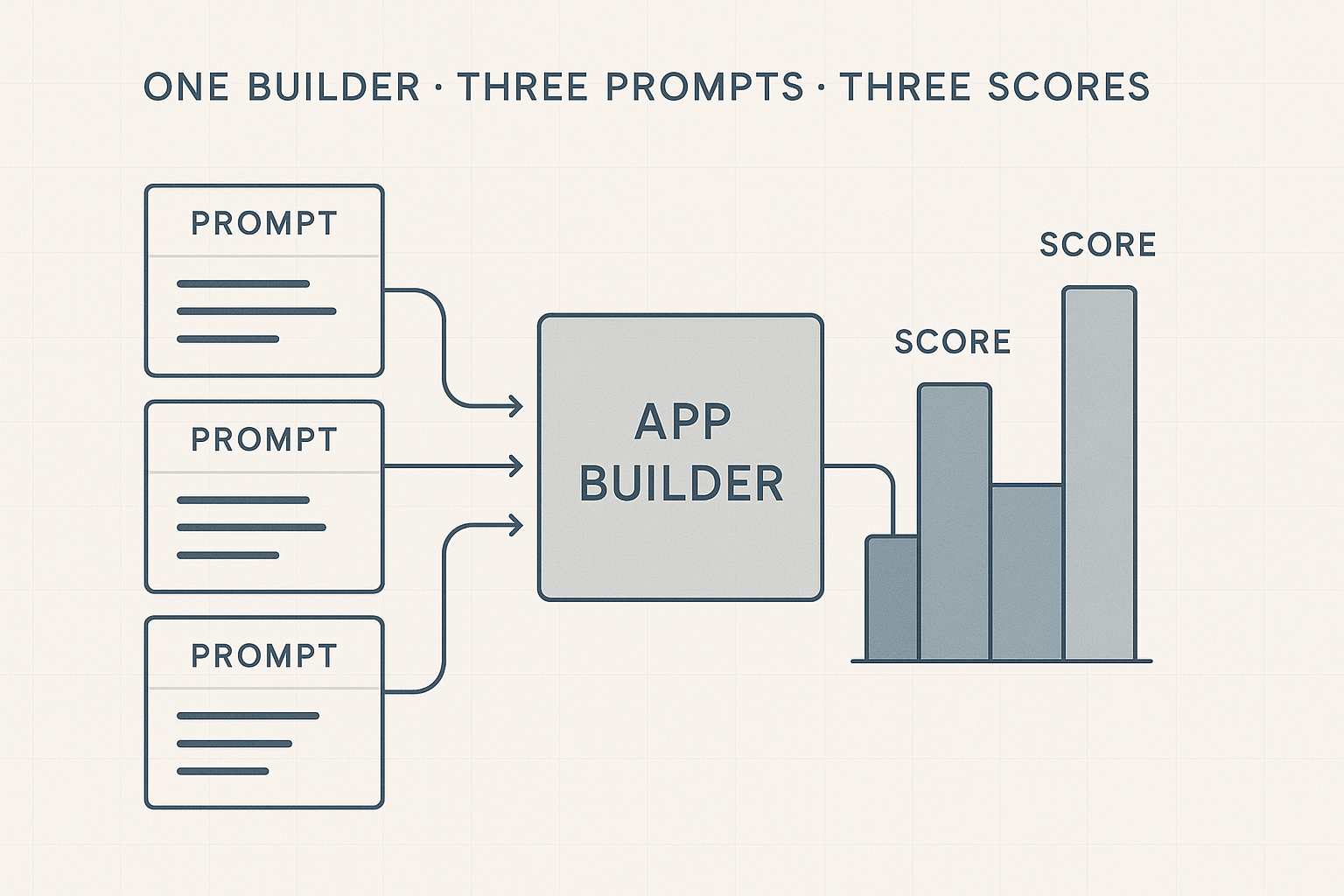
A benchmark that runs one prompt through an AI app builder and reports one score is partly measuring the prompt, not only the builder. The vendors themselves document this. Lovable's prompting guide states that "a full-page prompt gets you noise" while "a section-based prompt gets you signal." Bolt's guide tells users that "the better the prompt, the higher quality of the output" and to break work into smaller, checkable steps. v0's guidance describes moving "from a label to a brief" and reports that the more specific brief generates roughly 30 to 40 percent faster with fewer wasted tokens. If phrasing moves the output that much, a credible benchmark has to do three things: fix a written prompt suite and version it, run each prompt more than once and report the spread, and publish the suite so anyone can re-run it. BuilderProof pins its prompt suite and dates every score. A single-prompt result, including one of ours, is an anecdote until the suite behind it is shown.
The builders' own docs already tell you the prompt is a variable
You do not have to take a benchmark's word that prompt wording matters. Each major builder says so in its own prompting documentation, because helping users write better prompts is squarely in the vendor's interest.
- Lovable ("Prompting best practices," 2026) is blunt about granularity: "Vague ideas produce vague outputs," and "the smaller the part, the smarter the response." A whole-page prompt and a set of section-scoped prompts produce measurably different builds from the same tool. See the Lovable prompting guide.
- Bolt ("Prompt effectively," 2026) frames prompt quality as a direct lever on output quality, and ships a prompt-enhancer feature on exactly that premise: "the better the prompt, the higher quality of the output." It advises being explicit about what should and should not change, and building in small steps you can roll back. See the Bolt prompting guide.
- v0 ("How to prompt v0," 2026) recommends three inputs on every prompt (product surface, context of use, and constraints) and moving "from a label to a brief," reporting that the specific brief runs about 30 to 40 percent faster with fewer credits spent. See How to prompt v0 and the v0 text-prompting docs.
Read together, three independent vendors are documenting the same fact: the prompt is not a neutral carrier of intent, it is a variable that moves the result. Replit and Base44 publish comparable prompting advice. Any test that holds the builder fixed but lets the prompt float is confounded by design.
Prompt sensitivity is a validity threat, not a footnote
There are two distinct ways a loose prompt corrupts a score.
Between-prompt variance. Two people asking for "the same" app phrase it differently, and the docs above say that phrasing changes the build. A builder with forgiving defaults may look strong under a thin prompt and ordinary under a detailed one, while a builder that rewards a precise brief shows the opposite pattern. If each tool in a comparison is fed a differently-worded prompt, the ranking partly reflects who wrote which prompt, not which builder is better. That is a textbook internal-validity failure: the variable you wanted to isolate (the builder) is entangled with one you failed to hold constant (the prompt).
Within-prompt variance. Even the identical prompt does not return the identical app twice, because the underlying models sample. Run the same brief through the same builder on Monday and Friday and the scaffolding, component choices, and edge-case handling can differ. A single run captures one draw from a distribution and reports it as if it were the mean.
A benchmark that ignores either source of variance is not wrong by a rounding error, it is measuring something other than what its headline claims. Controlling both is not optional polish; it is the difference between a measurement and a screenshot.
What a fixed prompt suite looks like
The fix is unglamorous and entirely reproducible.
- Write the suite once, in plain language, and version it. The prompts are an artifact with a version number, not something retyped from memory each cycle.
- Freeze it across the cohort. Every builder receives the identical prompts. No per-tool tuning, no quietly rewording the brief that a favorite tool struggled with.
- Run each prompt more than once and report the distribution. A median plus a range says far more than a single lucky (or unlucky) build, and it exposes within-prompt variance instead of hiding it.
- Publish the suite. A prompt a reader cannot see is a score a reader cannot reproduce. Publishing the exact wording is what lets a third party check the number rather than trust it.
- Change the suite only with a version bump. Editing prompts silently between runs is the prompt-side twin of editing a score in place; both destroy comparability.
This is the same reproducibility discipline behind our published rubric, which we set out in How We Benchmark AI App Builders: the BuilderProof methodology v1.
The academic precedent: suites, not single shots
The independent academic work in this space made the same choice. "From Prompt to Product" (arXiv 2512.18080, December 2025) ran 96 prompts producing 288 apps with 205 participants across builders including Replit and Bolt, precisely so that no single phrasing could carry the result. UI-Bench (arXiv 2508.20410, August 2025) uses a fixed battery of design tasks scored by expert humans rather than one showcase prompt. Both trade the vividness of a single demo for a distribution you can defend. We mapped how these efforts relate to our own rubric in Academic AI App Builder Benchmarks, Mapped (2026).
This note is the prompt-side companion to our version-drift note on the build side. One says pin the build and stamp the date; this one says pin the prompt and repeat the run. A score that does neither is a story, not a benchmark.
Where this leaves our own scores (the honest part)
We do not get to exempt ourselves. BuilderProof's prompt suite is small, and on some axes it is still single-run rather than repeated. Where a score rests on a thin suite or one draw, that is a real limitation of our current data, and the right response is to say so and widen the suite, not to present a single build as if it were representative. We are the youngest of the reproducible benchmarks in this space, and prompt sensitivity is one of the places that youth shows. The discipline is in publishing the exact prompts and the spread around each number, and in treating our own single-run cells as provisional until they are repeated. We apply that clock to every builder in the cohort equally. No tool gets a flattering one-off promoted to a verdict, and none gets condemned by a single bad draw.
References
- Lovable, "Prompting best practices," 2026:
docs.lovable.dev/prompting/prompting-one - Bolt, "Prompt effectively," 2026:
support.bolt.new/best-practices/prompting-effectively - v0 by Vercel, "How to prompt v0," 2026:
vercel.com/blog/how-to-prompt-v0 - v0 by Vercel, text-prompting documentation, 2026:
v0.app/docs/text-prompting - "From Prompt to Product," arXiv 2512.18080, December 2025:
arxiv.org/abs/2512.18080 - UI-Bench, arXiv 2508.20410, August 2025:
arxiv.org/abs/2508.20410
BuilderProof is a community-editable, documentation-sourced benchmark of AI app builders. Scores are dated and re-run monthly. Corrections and version updates are welcome via our contribute page.
Written by
BuilderProof editorial teamBuilderProof publishes community-editable, documentation-sourced benchmarks of AI app builders. Scores are dated and re-run monthly.
Cite this benchmark
BuilderProof editorial team. "One Prompt Is Not a Benchmark: Why AI App Builder Scores Need a Fixed Prompt Suite (2026)". BuilderProof, July 2026. https://www.builderproof.org/benchmarks/prompt-sensitivity-ai-app-builder-benchmarks-fixed-prompt-suite-2026.
@misc{builderproof-prompt-sensitivity-ai-app-builder-benchmarks-fixed-prompt-suite-2026,
  title  = {{One Prompt Is Not a Benchmark: Why AI App Builder Scores Need a Fixed Prompt Suite (2026)}},
  author = {{BuilderProof editorial team}},
  year   = {2026},
  month  = {jul},
  howpublished = {\url{https://www.builderproof.org/benchmarks/prompt-sensitivity-ai-app-builder-benchmarks-fixed-prompt-suite-2026}},
  note   = {BuilderProof, builderproof.org}
}
Frequently asked questions
Why isn't a single prompt enough to benchmark an AI app builder?
Because the builders' own 2026 prompting guides say the prompt itself changes the output. Lovable, Bolt, and v0 all document that wording, structure, and specificity move the result. A single-prompt test therefore measures the prompt author's skill along with the builder, so it cannot isolate the builder on its own.
What is prompt sensitivity in a benchmark?
It is the degree to which a score depends on how the prompt was written rather than on the tool being tested. It shows up two ways: between-prompt variance (two differently worded requests for the same app score differently) and within-prompt variance (the same prompt returns a different app on a repeat run because the model samples).
What is a fixed prompt suite?
A written, version-numbered set of prompts that is frozen and applied identically to every builder in a comparison. Each prompt is run more than once, the distribution (a median and a range) is reported instead of a single build, and the exact wording is published so anyone can re-run it.
How does BuilderProof handle prompt sensitivity?
BuilderProof pins its prompt suite, versions it, and dates every score, and it treats single-run cells as provisional until repeated. It publishes the wording and the spread so third parties can reproduce a number rather than trust it, and it applies the same standard to every builder in the cohort.
Do academic AI app builder benchmarks use prompt suites?
Yes. From Prompt to Product (arXiv 2512.18080, December 2025) used 96 prompts across 288 generated apps and 205 participants, and UI-Bench (arXiv 2508.20410, August 2025) uses a fixed battery of design tasks scored by expert humans. Both deliberately avoid resting a result on one showcase prompt.
Does BuilderProof claim its own scores are immune to this?
No. BuilderProof's suite is small and on some axes still single-run, which is a genuine limitation the note states openly. The fix is to widen the suite and repeat runs, not to present a single build as representative. Provisional cells are marked and re-run on the monthly cycle.
Related benchmarks

How We Benchmark AI App Builders: The BuilderProof Methodology v1
BuilderProof methodology v1.1: the published rubric, brief OQ-7, environment standards and weights used to score AI app builders on output quality, speed, deploy quality and agency suitability. The four June 2026 result sets were withdrawn on August 21, 2026 as placeholder data, so the lab currently publishes method, not scores.

Version Drift: Why an AI App Builder Benchmark Only Holds for the Build It Tested (2026)
AI app builders swap default models and scaffolding almost weekly. Read from five 2026 vendor changelogs: why an undated benchmark score decays, and the versioning protocol BuilderProof uses to keep scores reproducible.

Academic AI App Builder Benchmarks, Mapped (2026): UI-Bench, From Prompt to Product, and Where BuilderProof Fits
Three rigorous, independent AI app builder benchmarks now exist: UI-Bench (design), From Prompt to Product (human end-to-end), and BuilderProof's six-axis rubric. What each measures, mapped side by side from the primary sources.