Version Drift: Why an AI App Builder Benchmark Only Holds for the Build It Tested (2026)
AI app builders swap default models and scaffolding almost weekly. Read from five 2026 vendor changelogs: why an undated benchmark score decays, and the versioning protocol BuilderProof uses to keep scores reproducible.

On this page
Abstract. A benchmark number is a measurement, and every measurement has to record when it was taken and on what. AI app builders ship changes to their default models, agents, and scaffolding on a near-weekly cadence, which means a score collected one week can quietly stop describing the product a reader tries the next. This lab note documents the release velocity we observed across v0, Bolt, Lovable, Replit, and Base44 in the first half of 2026, read directly from each vendor's own changelog, explains why undated scores decay, and sets out the versioning protocol BuilderProof uses to keep its scores reproducible. It applies to every builder in the cohort equally. None is singled out.
Quick answer (July 2026)
A benchmark score for an AI app builder is only valid for the exact build and default model it was collected on. In the first half of 2026 the major builders each shipped changes that move the very attributes benchmarks measure. Bolt replaced its named model picker with two agents, Standard and Max, and added the Opus 4.6 model. Lovable made server-side rendering the default for new apps as of May 13, 2026. v0 rebuilt around Git, an in-app code editor, and Mini/Pro/Max model tiers. Replit added an install-time package firewall. Base44 added Fable 5 as a model option. Any responsible benchmark therefore has to do two things: stamp the version and date it tested, and re-run when a builder ships a material change. BuilderProof pins the build and re-runs on a monthly clock. A score without a version stamp is noise, and that includes ours.
A measurement without a timestamp is noise
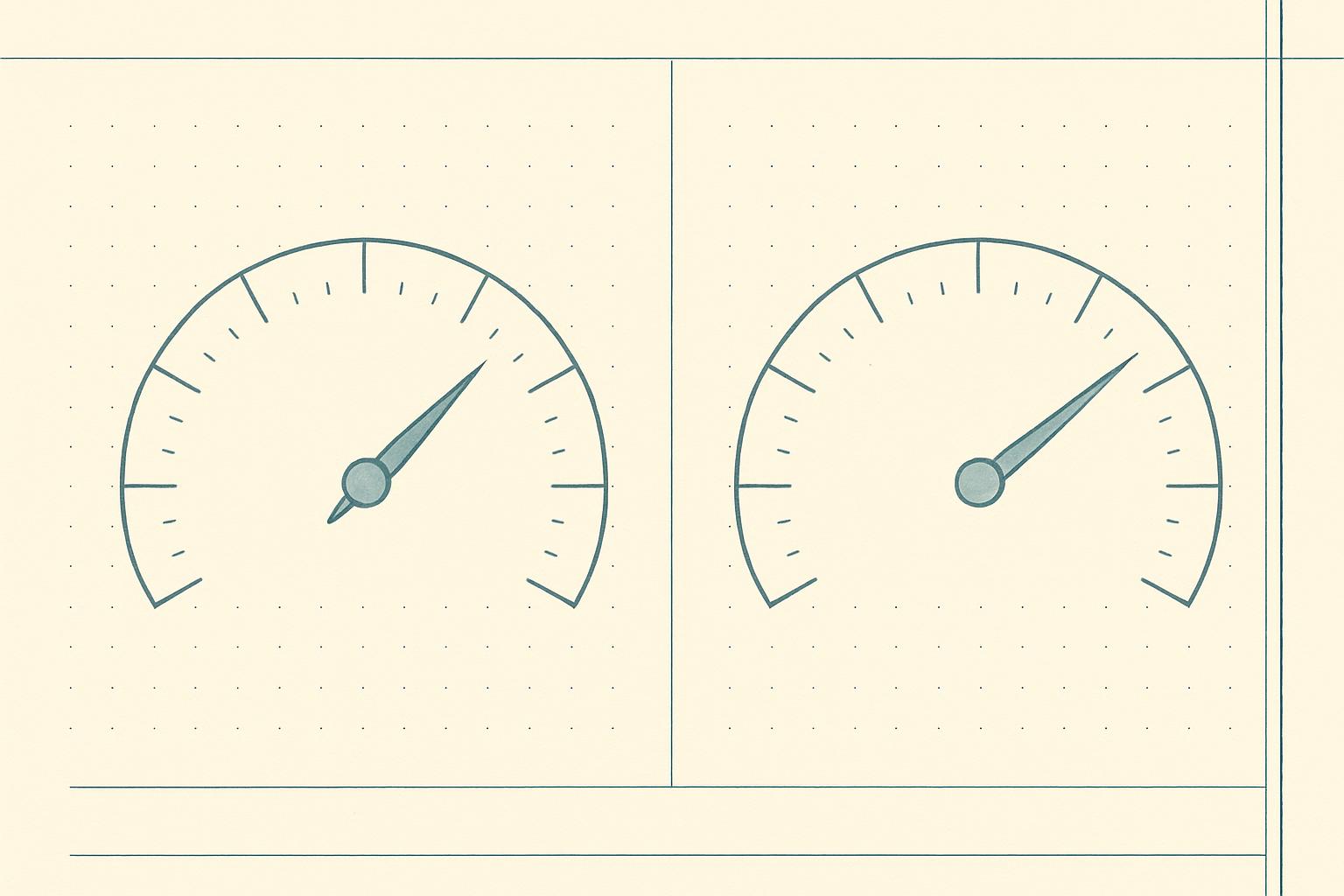
Reproducibility is the whole reason a benchmark is worth more than a screenshot. If a reader cannot tell which build produced a number, they cannot check it, cannot compare it to a later run, and cannot know whether it still holds. This is the principle behind our published rubric (see How We Benchmark AI App Builders: the BuilderProof methodology v1), and it is why even a single axis can produce different numbers on two consecutive runs when the tooling underneath shifts (we walked through one such case in why two Lighthouse runs disagree).
For static software, versioning is a solved habit: you cite the commit, the release tag, the date. AI app builders make this harder in two ways. The default model behind the "build" button changes without a version bump the user sees, and the scaffolding the builder emits changes with it. Both are invisible unless you go read the changelog. So we go read the changelog.
What actually shipped in the first half of 2026
Every row below is drawn from the vendor's own public release notes, dated to 2026. The point is not to rank these changes. It is to show that the surface a benchmark measures moved under all five builders inside a single six-month window.
Scroll to see more
| Builder | Dated change (2026) | Axis it can move | Primary source |
|---|---|---|---|
| Bolt | Named model options replaced by two agents (Standard, Max); Opus 4.6 added with variable effort; legacy v1 Agent blocked for new projects as of April 13, 2026 | Output quality, iteration fidelity | Bolt release notes |
| Lovable | New apps default to TanStack Start with server-side rendering as of May 13, 2026; Versioning 2.0 shipped | Deploy quality, output quality | Lovable changelog, Versioning 2.0 note |
| v0 | February 2026 rebuild added Git integration, an in-app editor, database connectivity, and agentic workflows; Mini/Pro/Max model tiers | Portability, output quality | v0 changelog |
| Replit | Package Firewall added to block malicious dependencies at install; Agent Voice Mode and new MCP servers | Auth/security posture, build flow | Replit documentation |
| Base44 | Fable 5 added as a selectable model in the AI chat | Output quality, iteration fidelity | Base44 changelog |
A reader who benchmarked Bolt in March 2026 on a named model was not testing the same product a reader who opened Bolt in June found waiting behind the Standard agent. A Lovable deploy-quality score from April, taken before server-side rendering became the default, describes a scaffolding the builder no longer emits for new apps. Neither original number was wrong. Both simply expired.
Why release velocity breaks naive benchmarks
Map the changes above onto what benchmarks actually score and the failure mode is obvious:
- Default-model swaps move output quality and iteration fidelity. When the model behind the build button changes, the code it writes and how well it revises on the second prompt change with it. Bolt's move to Standard/Max agents and Base44's Fable 5 option both sit on this axis.
- Scaffolding changes move deploy quality and portability. Lovable defaulting to server-side rendering changes the shape of the shipped app, its SEO surface, and its Lighthouse profile. v0's rebuild around Git and an editor changes how portable the output is.
- Guardrail changes move security posture. Replit's install-time package firewall changes the security story of what gets shipped, independent of the model.
An undated leaderboard flattens all of this into a single "current" claim it cannot actually support. The honest unit is not "Builder X scores N." It is "Builder X scored N on [default model], tested [date]."
How BuilderProof pins the build
Our protocol is deliberately boring, because boring is what reproducible looks like:
- Record the build coordinates. For every scored run we log the test date, the default model or agent in effect, and the plan tier used. These travel with the score.
- Version the scorecard, not just the post. A re-run produces a new dated row, and the prior row is kept, not overwritten, so the delta is visible.
- Re-run on a monthly clock, and on material releases. A default-model swap, a scaffolding change, or a new guardrail (exactly the five events above) triggers a re-benchmark rather than a silent edit to an old number.
- Publish the caveat, not just the number. Where a score predates a change we have logged, we say so and mark it for re-run instead of presenting it as current.
This is also why our cohort work leans on documentation-sourced axes wherever possible: a claim traced to a dated changelog line is re-checkable by anyone, in a way a one-off hands-on impression is not. It is the same reason we treat independent academic efforts as complementary rather than competing, which we mapped in Academic AI App Builder Benchmarks, Mapped (2026).
Where this leaves our own scores (the honest part)
Two of the changes documented above land on cohort members we scored earlier in 2026, which means some of our own published numbers are now pre-change snapshots awaiting a re-run. We do not get to exempt ourselves from the rule in this note. Every BuilderProof score carries its test date for exactly this reason, and the ones the 2026 changelogs have overtaken are queued for the next monthly cycle. We apply the same clock to every builder in the cohort. No vendor gets a frozen favorable snapshot, and no vendor gets held to a stale bad one. BuilderProof is the youngest of the reproducible benchmarks in this space, and version drift is one of the places that youth shows: the discipline is in admitting which numbers have expired, not in pretending they never do.
References
- Bolt, release notes, 2026: https://support.bolt.new/release-notes
- Lovable, changelog, 2026: https://docs.lovable.dev/changelog
- Lovable, Versioning 2.0, 2026: https://lovable.dev/blog/versioning-with-lovable-two-point-zero
- v0 by Vercel, changelog, 2026: https://v0.app/changelog
- Vercel, "Introducing the new v0," 2026: https://vercel.com/blog/introducing-the-new-v0
- Replit, documentation, 2026: https://docs.replit.com
- Base44, changelog, 2026: https://base44.com/changelog
BuilderProof is a community-editable, documentation-sourced benchmark of AI app builders. Scores are dated and re-run monthly. Corrections and version updates are welcome via our contribute page.
Written by
BuilderProof editorial teamBuilderProof publishes community-editable, documentation-sourced benchmarks of AI app builders. Scores are dated and re-run monthly.
Cite this benchmark
BuilderProof editorial team. "Version Drift: Why an AI App Builder Benchmark Only Holds for the Build It Tested (2026)". BuilderProof, July 2026. https://www.builderproof.org/benchmarks/version-drift-ai-app-builder-benchmarks-pinning-the-build-2026.
@misc{builderproof-version-drift-ai-app-builder-benchmarks-pinning-the-build-2026,
  title  = {{Version Drift: Why an AI App Builder Benchmark Only Holds for the Build It Tested (2026)}},
  author = {{BuilderProof editorial team}},
  year   = {2026},
  month  = {jul},
  howpublished = {\url{https://www.builderproof.org/benchmarks/version-drift-ai-app-builder-benchmarks-pinning-the-build-2026}},
  note   = {BuilderProof, builderproof.org}
}
Frequently asked questions
Do AI app builder benchmark scores expire?
Yes. Because builders change their default models and scaffolding frequently, a score is only valid for the build and date it was collected. In the first half of 2026, Bolt, Lovable, v0, Replit and Base44 each shipped changes that move benchmarked attributes, so any undated score can silently go stale.
What changed across the major AI app builders in 2026?
Per their own changelogs: Bolt replaced named models with Standard and Max agents and added Opus 4.6; Lovable defaulted new apps to server-side rendering as of May 13, 2026; v0 rebuilt around Git and Mini/Pro/Max model tiers; Replit added an install-time package firewall; Base44 added Fable 5 as a model option.
How should a benchmark handle frequent vendor updates?
By pinning the version. Record the test date, default model, and plan tier with every score; keep prior runs instead of overwriting them; and re-run on a fixed cadence plus whenever a vendor ships a material change.
How often does BuilderProof re-run its benchmarks?
On a monthly clock, and additionally whenever a builder ships a material change such as a default-model swap, a scaffolding change, or a new guardrail. Older scores keep their test date and are queued for re-run rather than silently edited.
Does version drift affect BuilderProof's own scores?
Yes, and we say so. Some of our earlier-2026 scores predate the changes documented here and are queued for re-run. Every BuilderProof score carries its test date, and we apply the same clock to every builder in the cohort.
Which AI app builder is the best in 2026?
This note does not rank builders; it is about benchmark methodology. BuilderProof scores each builder neutrally on dated, documentation-sourced axes and treats every vendor on the same clock, so any ranking is only meaningful next to the version and date it was measured on.
Related benchmarks

How We Benchmark AI App Builders: The BuilderProof Methodology v1
BuilderProof methodology v1.1: the published rubric, brief OQ-7, environment standards and weights used to score AI app builders on output quality, speed, deploy quality and agency suitability. The four June 2026 result sets were withdrawn on August 21, 2026 as placeholder data, so the lab currently publishes method, not scores.

Academic AI App Builder Benchmarks, Mapped (2026): UI-Bench, From Prompt to Product, and Where BuilderProof Fits
Three rigorous, independent AI app builder benchmarks now exist: UI-Bench (design), From Prompt to Product (human end-to-end), and BuilderProof's six-axis rubric. What each measures, mapped side by side from the primary sources.
Deploy quality: why two Lighthouse runs disagree (2026)
Two Lighthouse runs on the same deployed AI-builder output rarely return the same score. This note documents the variance phenomenon, names its seven sources from Google's own documentation, and publishes the median-of-five protocol a hands-on deploy-quality harness would have to meet. Corrected August 21, 2026: the June 2026 result table it accompanied has been withdrawn, and the account of how that table was produced is withdrawn with it.