Secrets-Handling Posture: A Proposed AI Builder Benchmark Axis
Code and data lock-in get benchmark axes; how a builder handles your API keys does not. A proposed BuilderProof axis with a reproducible five-check rubric and a preliminary July 2026 docs read across five AI app builders.
Updated on August 22, 2026
On this page
Quick Answer
Secrets-handling posture is how an AI app builder stores your API keys and environment secrets and keeps them out of the browser. It is distinct from end-user auth and from data portability, and no public AI-builder benchmark scores it yet. This July 2026 proposal defines a reproducible five-check rubric (dedicated store, server-side-only path, documented encryption at rest, active client-exposure guardrail, rotation guidance) and applies it to five builders (Lovable, Bolt.new, v0, Replit, Base44) using their own documentation. The preliminary read: all five ship a server-side secrets store, but they diverge on documented encryption at rest and on whether a client-exposure guardrail is active or merely conventional.
BuilderProof publishes proposed axes before scoring them, so the methodology is public and criticized before it becomes a leaderboard. This is the sixth axis in the series, after code portability, data-layer portability, iteration fidelity, auth posture, and cost-to-ship. It is a proposal, not a verdict.
Why secrets handling deserves its own axis
We already score how a builder handles the code it generates and the data it stores. Neither of those captures a third, separately-failing thing: the credentials the app needs to talk to Stripe, an email provider, or a model API.
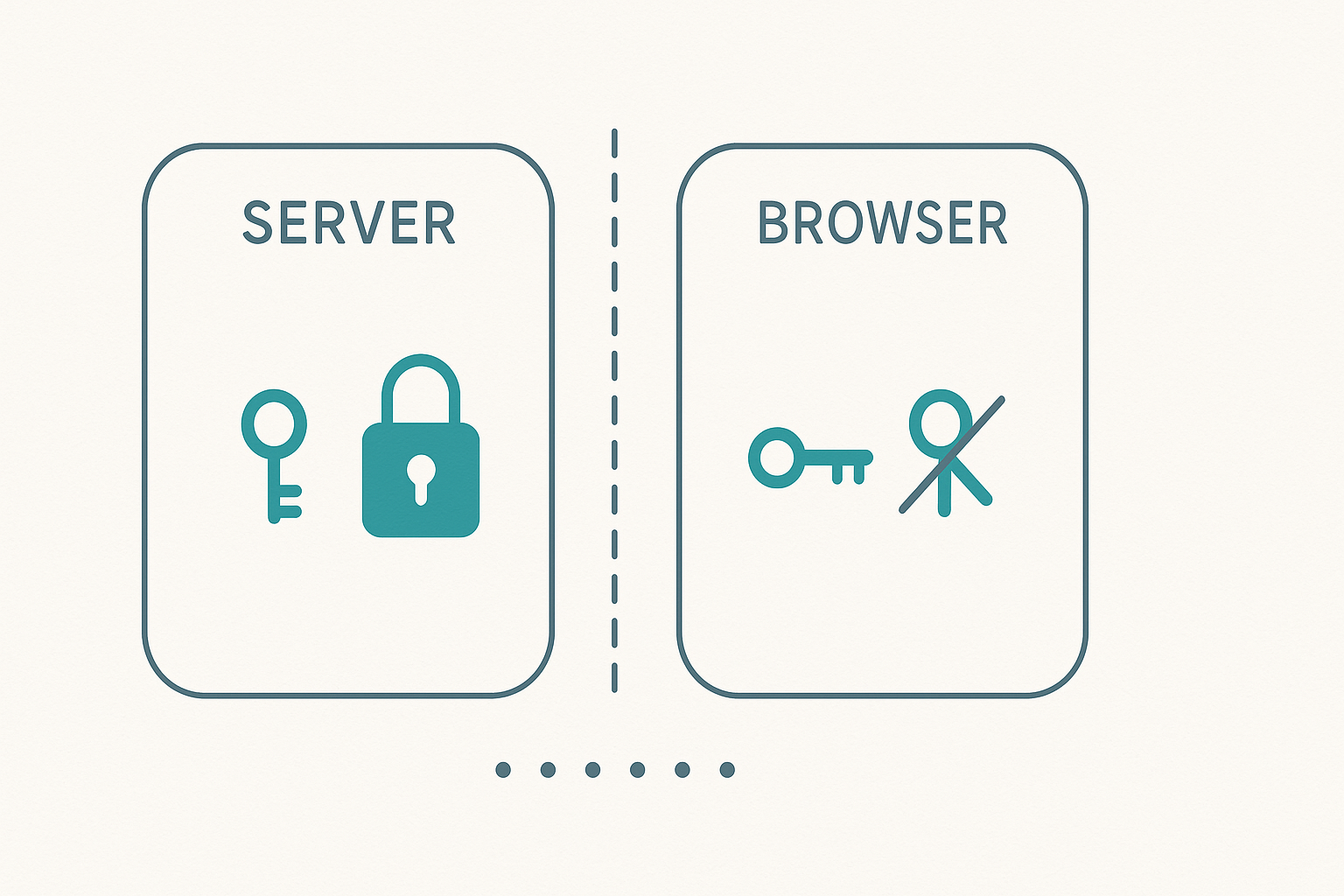
The failure mode is specific and severe. A leaked customer record is a breach of one row. A leaked service-role key or payment secret baked into a client bundle is a breach of the whole account, and it is exploitable by anyone who opens browser devtools. Note the scope boundary on the email provider named above: this axis asks whether the sending credential is stored and referenced safely, not whether the mail it sends actually arrives. That second question is scored separately by our transactional email and deliverability posture axis, proposed August 2026, where a correctly stored SMTP credential can still sit in front of a sender that refuses every address outside the project team. The mechanism is well documented: in a Next.js app, only variables prefixed NEXT_PUBLIC_ are inlined into the JavaScript sent to the browser, and everything else stays server-only (Next.js environment variables docs, 2026). Most AI builders generate exactly this kind of app, so the question "where does my API key end up" has a concrete, checkable answer per platform.
That makes secrets handling a good benchmark axis: it has a clear failure mode, a documented mechanism, and observable, per-vendor behavior. It also sits beside axes we already publish without overlapping them. It is not data-layer portability, which asks whether you can get your data out, and it is not code portability, which asks whether you own the generated code. It is a third, separately-failing property: where the running app's credentials live.
The proposed rubric: five checks
Each builder is scored on five documentation-verifiable checks. Each check is recorded as Documented, Partial, or Not documented. We deliberately avoid a single 0 to 10 number at the proposal stage; the point of publishing the rubric first is to let the cohort and readers argue with the checks before any score is attached.
- S1 - Dedicated secrets store. A first-class, documented secrets or environment manager exists, so a key never has to live in source code.
- S2 - Server-side-only execution path. The docs show secrets consumed by server, edge, or backend functions and state they are not shipped to the browser.
- S3 - Encryption at rest (documented). The vendor explicitly documents that stored secrets are encrypted at rest, not just "kept secure."
- S4 - Active client-exposure guardrail. A mechanism, beyond prose advice, that prevents or flags a secret leaking into client code: automatic detection, an enforced boundary, or "never visible to viewers" sharing behavior.
- S5 - Rotation and hygiene guidance. Documented guidance to rotate keys, remove unused ones, and never hardcode.
A note on scope: a check measures what the vendor documents, not what its infrastructure secretly does. "Not documented" means the public docs did not state it as of July 2026; it is not a claim that the platform is insecure.
Preliminary cohort read (July 2026)
We priced five builders on their own published docs: 


Scroll to see more
| Builder | S1 store | S2 server-only | S3 encryption at rest | S4 active guardrail | S5 hygiene |
|---|---|---|---|---|---|
| Lovable | Documented | Documented | Not documented | Documented | Partial |
| Bolt.new | Documented | Documented | Not documented | Documented | Documented |
| v0 (Vercel) | Documented | Documented | Documented | Partial | Not documented |
| Replit | Documented | Documented | Documented | Documented | Partial |
| Base44 | Documented | Documented | Not documented | Partial | Not documented |
The cohort converges on S1 and S2: every builder ships a documented secrets store and routes secrets through a server, edge, or backend function rather than the browser. Where they separate is S3 and S4.
Lovable
Lovable documents a Secrets feature and, distinctively, an active guardrail: it "automatically detects API keys pasted into the chat and guides you to store them securely in Secrets instead of hardcoding them into your code," and it steers users to "create an Edge Function to make the API call server-side" (Lovable security docs, 2026). That automatic detection is the strongest S4 in the cohort. Its published docs did not state encryption at rest (S3, Not documented) and emphasized storage over rotation (S5, Partial).
Bolt.new
Bolt provides a dedicated Secrets panel whose values are "never visible to viewers, so you can share projects without exposing secrets," used by "server functions (sometimes called edge functions)" so that "private information never ends up in your users' browsers or devices" (Bolt secrets docs, 2026). It is the only builder whose docs explicitly cover S5 hygiene: rotate keys regularly, remove unused keys, never store secrets in plain text. Encryption at rest was not explicitly stated (S3, Not documented).
v0 (Vercel)
v0 generates Next.js apps that run on Vercel, whose environment variables "are encrypted at rest" and are, by Next.js convention, server-only unless prefixed NEXT_PUBLIC_ (Vercel environment variables docs, June 2026). That earns a documented S3. Its S4 is scored Partial rather than Documented because the browser boundary is a framework convention the developer must apply correctly, not an active detector: a mislabeled NEXT_PUBLIC_ secret is inlined into the client bundle at build time exactly as designed.
Replit
Replit's Secrets tool "automatically encrypts the data and makes it available to your Replit App as an environment variable," using "AES-256 encryption at rest and TLS encryption in transit," and its visibility model hides values from non-owner remixers and viewers (Replit Secrets docs, 2026). Naming the cipher is the most explicit S3 in the cohort. S5 is Partial: the docs warn against hardcoding but say less about rotation.
Base44
Base44 exposes a secrets CLI (secrets set, secrets list, secrets delete) whose values "are available to your backend functions as environment variables via Deno.env.get()" (Base44 secrets docs, 2026). That is a clear S1 and S2. The surrounding hygiene surface is thinner in its public docs (S3 and S5 Not documented, S4 Partial). Consistent with our standing guardrail, thin docs are scored conservatively and are not read as proof of weak infrastructure.
Guardrails on this reading
Three limits, stated plainly so the axis stays honest.
First, documentation is a proxy. A vendor can encrypt secrets at rest without saying so; a "Not documented" is a gap in the public docs on the date read, not a security finding.
Second, a server-side managed backend is not automatically better or worse than a bring-your-own-key model. It is a different trust boundary, and this axis measures documented handling, not architecture preference.
Third, these are point-in-time reads for July 2026. Docs change. Every cell above links to its source so the check can be re-run and disputed. That is the whole design: our benchmark methodology is public first and scored second.
How to reproduce this
- Open the builder's docs and search for "secret", "environment variable", and "API key".
- Record S1 through S5 as Documented, Partial, or Not documented, pasting the exact sentence you relied on.
- For S4, verify whether the guardrail is active (auto-detection, enforced boundary, viewer-invisible sharing) or a convention the developer must apply.
- Date every read. Re-run quarterly, because this is a moving target.
If you find a doc that changes a cell, that is a contribution, not a correction to argue with. The rubric is meant to be edited.
References
- Next.js, "Environment variables" (client-inlining and
NEXT_PUBLIC_rule), 2026: https://nextjs.org/docs/app/guides/environment-variables - Lovable, "Security" (Secrets, automatic key detection, Edge Function pattern), 2026: https://docs.lovable.dev/features/security
- Bolt, "Database: Secrets settings" (server functions, viewer-invisible, rotation guidance), 2026: https://support.bolt.new/cloud/database/secrets
- Vercel, "Environment variables" (encrypted at rest, server-side by default), June 2026: https://vercel.com/docs/environment-variables
- Replit, "Secrets" (AES-256 at rest, TLS in transit, env-var injection), 2026: https://docs.replit.com/replit-workspace/workspace-features/secrets
- Base44, "secrets set" (CLI secrets, backend
Deno.env.get()), 2026: https://docs.base44.com/developers/references/cli/commands/secrets-set
Written by
BuilderProof editorial teamThe BuilderProof editorial team maintains community-editable, documentation-sourced benchmarks of AI app builders. We publish methodology before scores and keep every axis reproducible.
Cite this benchmark
BuilderProof editorial team. "Secrets-Handling Posture: A Proposed AI Builder Benchmark Axis". BuilderProof, July 2026. https://www.builderproof.org/benchmarks/secrets-handling-posture-axis-proposal-july-2026.
@misc{builderproof-secrets-handling-posture-axis-proposal-july-2026,
  title  = {{Secrets-Handling Posture: A Proposed AI Builder Benchmark Axis}},
  author = {{BuilderProof editorial team}},
  year   = {2026},
  month  = {jul},
  howpublished = {\url{https://www.builderproof.org/benchmarks/secrets-handling-posture-axis-proposal-july-2026}},
  note   = {BuilderProof, builderproof.org}
}
Frequently asked questions
What is secrets-handling posture for an AI app builder?
It is how the builder stores your API keys and environment secrets and keeps them out of the browser. It is separate from end-user authentication and from data portability, and this proposal scores it on five documentation-verifiable checks.
Is a leaked API key worse than a leaked database row?
Usually yes. A leaked row exposes one record; a leaked service-role or payment key baked into a client bundle can expose the whole account and is readable by anyone who opens browser devtools. That severity is why secrets handling deserves its own axis.
Does the NEXT_PUBLIC_ prefix expose a variable to the browser?
Yes. In Next.js, only variables prefixed NEXT_PUBLIC_ are inlined into the client JavaScript at build time; everything else stays server-only, per the Next.js 2026 environment-variables docs. Most AI builders generate Next.js-style apps, so a mislabeled secret can end up in the browser exactly as designed.
Do Lovable, Bolt.new, v0, Replit, and Base44 keep secrets server-side?
All five document a server-side secrets store and route secrets through server, edge, or backend functions rather than the browser. They diverge on documented encryption at rest (Vercel and Replit state it explicitly; Replit names AES-256) and on whether the client-exposure guardrail is active, such as Lovable's automatic key detection, or a convention the developer must apply.
Why score documentation instead of testing the platforms directly?
Because a public, source-linked documentation read is reproducible and disputable: anyone can re-run it and challenge a cell. A vendor may encrypt secrets without documenting it, so a Not-documented mark is a gap in the public docs on the date read, not a security finding.
Related benchmarks
Data-Layer Portability: A Proposed BuilderProof Axis for Whether You Can Take Your Database With You (July 2026)
Benchmarks measure whether you can leave an AI app builder with your code. Almost none measure whether you can leave with your data. A proposed sixth-family BuilderProof axis with a five-check rubric and preliminary, docs-based reads of five builders.
Code-portability: a v2 axis proposal (June 2026)
We are proposing a fifth BuilderProof axis to score whether an AI app builder ships code that can leave the platform. Five sub-axes, 0 to 100, provisional cohort scores included.

How We Benchmark AI App Builders: The BuilderProof Methodology v1
BuilderProof methodology v1.1: the published rubric, brief OQ-7, environment standards and weights used to score AI app builders on output quality, speed, deploy quality and agency suitability. The four June 2026 result sets were withdrawn on August 21, 2026 as placeholder data, so the lab currently publishes method, not scores.